
SEO vs Google Ads which gives better better ROI
Businesses looking to increase their online visibility often face a common question: SEO or Google Ads—which delivers better return on investment (ROI)? Both strategies are powerful digital marketing techniques, but they serve different purposes and produce results in different ways. Search Engine Optimization (SEO) focuses on improving a website’s organic visibility on search engines through keyword optimization, quality content, technical improvements, and backlink building. Although SEO requires patience and continuous effort, it offers long-term benefits and sustainable traffic growth. Once a website begins ranking for valuable keywords, it can attract visitors consistently without paying for every click. This makes SEO a cost-effective strategy for businesses that want to build authority, increase brand trust, and generate leads over time. Users often trust organic search results more than paid advertisements because they perceive them as more credible and relevant. In addition, SEO improves the overall user experience by enhancing website speed, mobile responsiveness, content quality, and navigation. These improvements not only help search rankings but also increase conversion rates and customer satisfaction. Another major advantage of SEO is its compounding effect. A well-optimized blog article or webpage can continue driving traffic for months or even years after publication, resulting in a higher ROI in the long run. Businesses investing in content marketing and local SEO can strengthen their online presence while reducing dependency on advertising budgets. However, SEO has limitations. It takes time to achieve rankings, competition can be intense, and algorithm updates may affect performance. This is where Google Ads becomes a valuable alternative. Google Ads allows businesses to appear instantly at the top of search engine results by paying for targeted keywords. Unlike SEO, which requires time to gain momentum, Google Ads delivers immediate visibility and can start generating traffic and leads within hours of launching a campaign. Businesses can target specific audiences based on demographics, location, devices, and user behavior, ensuring that advertisements reach potential customers who are actively searching for products or services. This level of precision helps companies maximize conversions and achieve short-term marketing goals. Google Ads also provides measurable data and performance analytics, enabling marketers to optimize campaigns and improve ROI continuously. Businesses launching new products, promoting seasonal offers, or operating in highly competitive markets often benefit from the speed and flexibility offered by paid advertising. However, Google Ads comes with ongoing costs. Once the advertising budget stops, traffic and lead generation usually stop as well. Highly competitive industries may experience increasing cost-per-click rates, making campaigns expensive over time. Therefore, relying solely on paid advertising may not always provide sustainable growth. While Google Ads excels in delivering immediate results, SEO remains a long-term investment that builds lasting visibility and authority. The decision between SEO and Google Ads depends on business objectives, budget, competition, and desired timelines. Companies seeking quick results and immediate sales may prefer Google Ads, whereas businesses focused on sustainable growth and long-term profitability often prioritize SEO. In many cases, the most effective strategy is not choosing one over the other but integrating both approaches to maximize performance. SEO can provide consistent organic traffic while Google Ads can generate instant visibility and support promotional campaigns. Together, they create a balanced digital marketing strategy that improves brand awareness, increases website traffic, and enhances overall marketing efficiency.
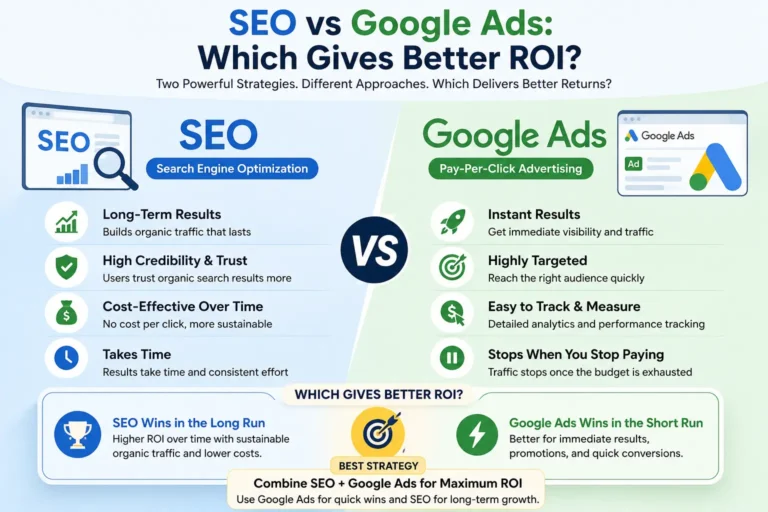
When comparing ROI between SEO and Google Ads, understanding the difference between short-term and long-term returns is essential. SEO generally delivers a higher ROI over time because the traffic generated through organic rankings continues even after the initial investment in optimization and content creation. For example, a well-written blog targeting high-value keywords can attract visitors continuously without additional advertising expenses. This makes SEO particularly beneficial for small businesses and companies with limited marketing budgets. Furthermore, SEO contributes to brand authority and trust. Websites appearing naturally on the first page of Google are often viewed as industry leaders, which positively influences customer perception and purchasing decisions. Strong organic rankings also increase click-through rates and improve customer acquisition costs over time. Google Ads, on the other hand, provides a predictable and scalable way to generate leads quickly. Businesses can control budgets, pause campaigns, test multiple advertisements, and monitor performance in real time. This flexibility makes Google Ads highly effective for product launches, event promotions, and businesses that need immediate visibility. However, paid advertising requires continuous investment, and ROI depends heavily on campaign optimization, keyword selection, landing page quality, and competition levels. If campaigns are poorly managed, businesses may spend significant amounts without achieving desired results. Another important factor influencing ROI is customer intent. Google Ads targets users with high purchase intent, making it ideal for driving conversions and immediate revenue. SEO, meanwhile, captures users at various stages of the buyer journey by providing informative content that educates and nurtures potential customers. This broader reach helps businesses build relationships and maintain visibility throughout the customer decision-making process. Competitive industries such as insurance, finance, healthcare, and legal services often experience higher advertising costs, which may reduce the profitability of Google Ads campaigns. In such cases, investing in SEO can provide a better long-term return. Conversely, businesses entering new markets or requiring rapid growth may benefit more from paid advertising initially. Measuring ROI also differs between both channels. SEO ROI is often evaluated through organic traffic growth, keyword rankings, engagement metrics, and conversions generated over extended periods. Google Ads ROI is measured using cost-per-click, conversion rates, cost-per-acquisition, and return on ad spend. Both methods provide valuable insights, but their effectiveness depends on the specific goals of the business. Rather than viewing SEO and Google Ads as competitors, successful businesses often combine both strategies to achieve maximum results. Google Ads can provide immediate traffic while SEO builds a strong foundation for future growth. Insights gathered from paid campaigns can even help identify high-performing keywords that can later be targeted through SEO content strategies. Similarly, strong SEO performance can reduce advertising expenses by generating free organic traffic. This integrated approach improves overall marketing efficiency and creates multiple channels for attracting customers. Ultimately, determining which strategy gives better ROI depends on the timeframe and objectives involved. For businesses seeking immediate leads and fast visibility, Google Ads often provides better short-term returns. For organizations focused on long-term growth, brand authority, and sustainable traffic, SEO typically offers superior ROI over time. The most successful digital marketing strategies recognize the strengths of both channels and use them together to create a comprehensive online presence. By balancing short-term advertising efforts with long-term optimization strategies, businesses can increase visibility, improve customer acquisition, and maximize their overall return on investment in the digital landscape.